

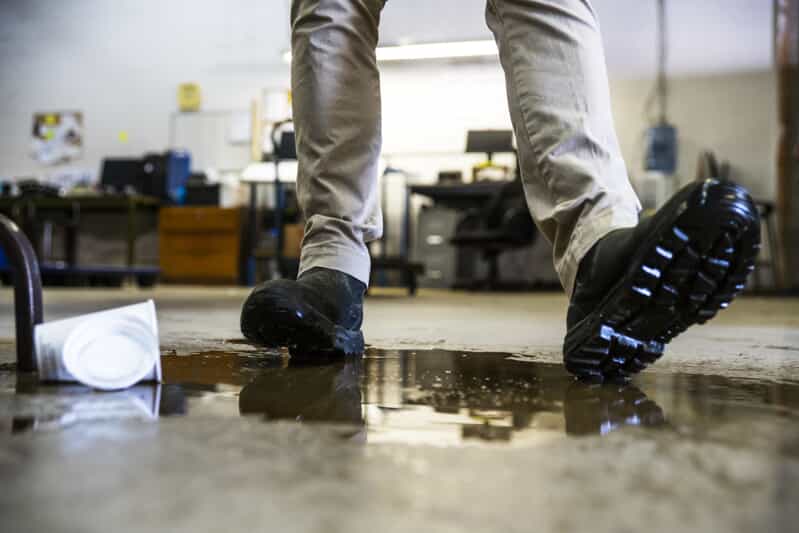
A seemingly simple “slip and fall” case can still raise complex litigation questions. A Florida appeals court recently explained how changes in state law can affect the rights of plaintiffs who have been injured on the premises of a business. Such cases demonstrate the importance of hiring an experienced Florida slip and fall accident attorney to defend your interests should you find yourself in a similar situation.
In 2008, Carrie Kenz slipped on some liquid and fell while traveling through Miami International Airport. She claimed to suffer permanent injuries from the fall and subsequently sued Miami-Dade County, which owns the airport, and one of the airport’s service providers for damages. A trial judge granted summary judgment in favor of the county in 2012. Kenz then appealed to the Third District Court of Appeals.
The reason Kenz lost on summary judgment had to do with the Florida legislature’s flip-flopping on the standard of proof in slip-and-fall cases. In 2001, the Florida Supreme Court decided that the burden should be on a facility owner to show the premises is well maintained. It was unnecessary, the court said at the time, to show the premises owner had specific knowledge of any “transitory foreign substance”—something like the liquid that caused Kenz’s fall—for a plaintiff to prevail. A year after the Supreme Court’s decision, the state legislature modified the rules further. Under the 2002 legislation, a plaintiff had the burden of proving a premises owner failed to exercise “reasonable care” in maintaining safe conditions. But the legislature agreed with the Supreme Court there was no need to show the owner had specific knowledge of any transitory foreign substance that caused injury.
This was the law in effect at the time Kenz sued Miami-Dade, which was 2009. In 2010, the legislature did an about-face and effectively revived the law as it existed before the Supreme Court’s 2001 decision. As of July 1, 2010, the rule in Florida is that a plaintiff must prove that a premises owner “had actual or constructive knowledge” of a transitory foreign substance.
Can the Law Apply Retroactively to My Case?
The question for the courts, then, in the Kenz case is which law to apply—the 2002 rule that did not require her to prove the airport knew (or should have known) about the liquid that caused her fall, or the 2010 rule that shifted that burden of proof to her. Ultimately, both the trial and appeals courts chose to apply the 2010 law. Since Kenz never presented any evidence the airport knew about the water on the floor that caused her fall, the appeals court upheld the trial court’s decision to grant summary judgment to the defendants. (The appeals court added that even under the 2002 law, the airport would still be entitled to summary judgment due to a lack of evidence.)
It may seem unfair to apply a law passed after Kenz filed her lawsuit to her case, but the appeals court explained this was appropriate since the law in question dealt with a procedural, rather than a substantive, right. In other words, the courts would not retroactively apply a law that created (or took away) a new right to sue someone. Kenz was able to sue Miami-Dade under the 2002 and 2010 laws. All the 2010 law did was change the procedural steps for proving her case.
Carrie Kenz may not have won her slip-and-fall case, but if you’re involved in a similar accident, it’s important you speak with an attorney who can advise you on your rights, not to mention any relevant changes in the law that might affect your ability to recover damages. To speak with a qualified attorney today, contact Zimmerman and Frachtman at (954) 504-6577.